Medical Disclaimer: This article is for informational purposes only and does not constitute medical advice. Do not start, stop, or change any medication or treatment protocol without consulting a licensed healthcare provider.
GLP-1 receptor agonists like semaglutide and tirzepatide have dramatically changed the obesity treatment landscape — but for a meaningful share of patients, monotherapy doesn’t produce adequate results. A new review published in Obesity Science & Practice in April 2026 examines the biological rationale for combining GLP-1 agonists with another approved weight-loss medication: naltrexone/bupropion extended-release (NB-ER).
The paper by Miras AD and Hussain M provides a mechanistic framework that could inform how clinicians approach treatment-refractory obesity in the coming years.
The Gut-Brain Axis: A Quick Primer
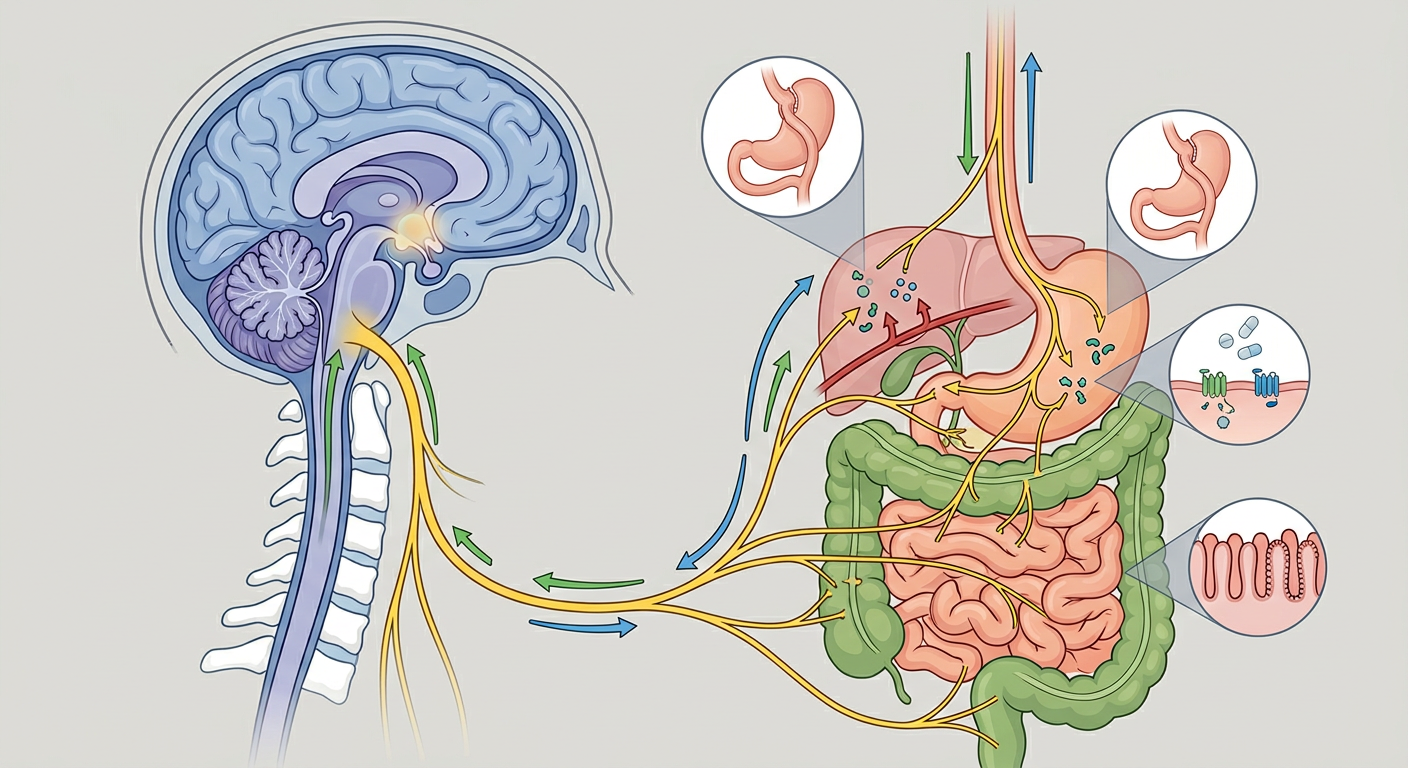
Obesity is not simply a matter of willpower or caloric arithmetic. It is driven by “metabolic, hormonal, and neural factors, the interconnection of which is referred to as the gut-brain axis,” as the review’s authors describe it.
When you eat, your gut releases hormones — including GLP-1 (glucagon-like peptide-1) — that travel through the bloodstream and are processed by brain regions including the hypothalamus and brainstem. These regions regulate hunger, fullness, and energy balance. But the story doesn’t end there: these same brain areas connect to the mesolimbic dopamine system, which drives reward-motivated behavior — including the urge to eat for pleasure rather than hunger.
This two-track system matters enormously for treatment, because:
- Metabolic/homeostatic eating is regulated primarily in the hypothalamus and brainstem
- Reward-driven eating (the “I’m not hungry but I really want pizza” phenomenon) is regulated by dopamine pathways
What GLP-1 Agonists Do Well — and Where They Fall Short
GLP-1 receptor agonists primarily work through the first pathway. Semaglutide and tirzepatide slow gastric emptying, reduce appetite signals in the hypothalamus, and increase satiety through brainstem mechanisms. The result is often dramatic reduction in overall caloric intake.
However, the review notes that GLP-1 agonists have inconsistent effects on reward-based eating. In some patients, the craving-driven urge to eat fatty, sweet, or highly processed foods diminishes substantially on GLP-1 therapy. In others, it does not — and these patients often plateau earlier or struggle to maintain behavioral changes even while feeling full.
What Naltrexone/Bupropion Adds
NB-ER (brand name Contrave in the US) works through the hypothalamic and mesolimbic pathways:
- Naltrexone is an opioid receptor antagonist that has been used for decades in addiction medicine. In the obesity context, it blocks reward signals associated with eating.
- Bupropion is a dopamine and norepinephrine reuptake inhibitor that activates hypothalamic pro-opiomelanocortin (POMC) neurons, which suppress appetite, while also modulating the mesolimbic reward system.
The combination addresses the reward-driven eating pathway more directly than GLP-1 agonists typically do — which is precisely what makes them mechanistically complementary, not redundant.
The Case for Combination Therapy
The authors argue that GLP-1 agonists and NB-ER have “distinct yet complementary mechanisms” that together could:
- Reduce homeostatic hunger (via GLP-1)
- Suppress reward-driven eating (via NB-ER’s dopamine/opioid pathway effects)
- Potentially achieve better outcomes in patients who don’t respond adequately to either drug alone
This isn’t purely theoretical. Obesity treatment routinely employs combinations — for example, tirzepatide’s dual GLP-1/GIP mechanism compared to semaglutide’s single GLP-1 mechanism. The principle that targeting multiple pathways improves outcomes is well-established in metabolic medicine.
What We Don’t Yet Know
This review provides mechanistic rationale, not clinical trial data. The combination of GLP-1 agonists + NB-ER in the same patient has not been validated in large, randomized controlled trials. Key unknowns include:
- Interaction effects: NB-ER includes bupropion, which affects dopamine signaling; combining it with GLP-1 agents (which also have CNS effects) requires careful safety evaluation
- Optimal sequencing: Should NB-ER be added to an established GLP-1 regimen, or started simultaneously?
- Which patients benefit most: Identifying the subgroup with pronounced reward-driven eating (versus predominantly homeostatic overeating) would help target this combination appropriately
The FDA has not approved any specific GLP-1 + NB-ER combination protocol, and off-label use of these medications together should only be considered under close medical supervision.
Why This Matters for the Peptide Field
This review is a useful reminder that obesity is a complex, multi-pathway condition. As interest in peptide-based therapies continues to grow — including ongoing research into other gut hormone analogs, amylin mimetics, and novel receptor agonists — understanding the distinct mechanisms at play becomes increasingly important for both researchers and informed consumers.
Source
Miras AD, Hussain M. “Targeting Multiple Gut-Brain Pathways in Obesity: Rationale for Combination Pharmacotherapy.” Obesity Science & Practice. April 2026. PMID: 41947825 | DOI: 10.1002/osp4.70141
Stay Informed on Peptide Research
Get the latest peptide research, regulatory updates, and clinical findings delivered to your inbox weekly. No spam — unsubscribe anytime.
No spam. Unsubscribe at any time. See our Privacy Policy.