Medical Disclaimer: This article is for informational purposes only and does not constitute medical advice. Do not start, stop, or change any medication or treatment protocol without consulting a licensed healthcare provider. All treatments mentioned are either investigational or approved only for specific indications.
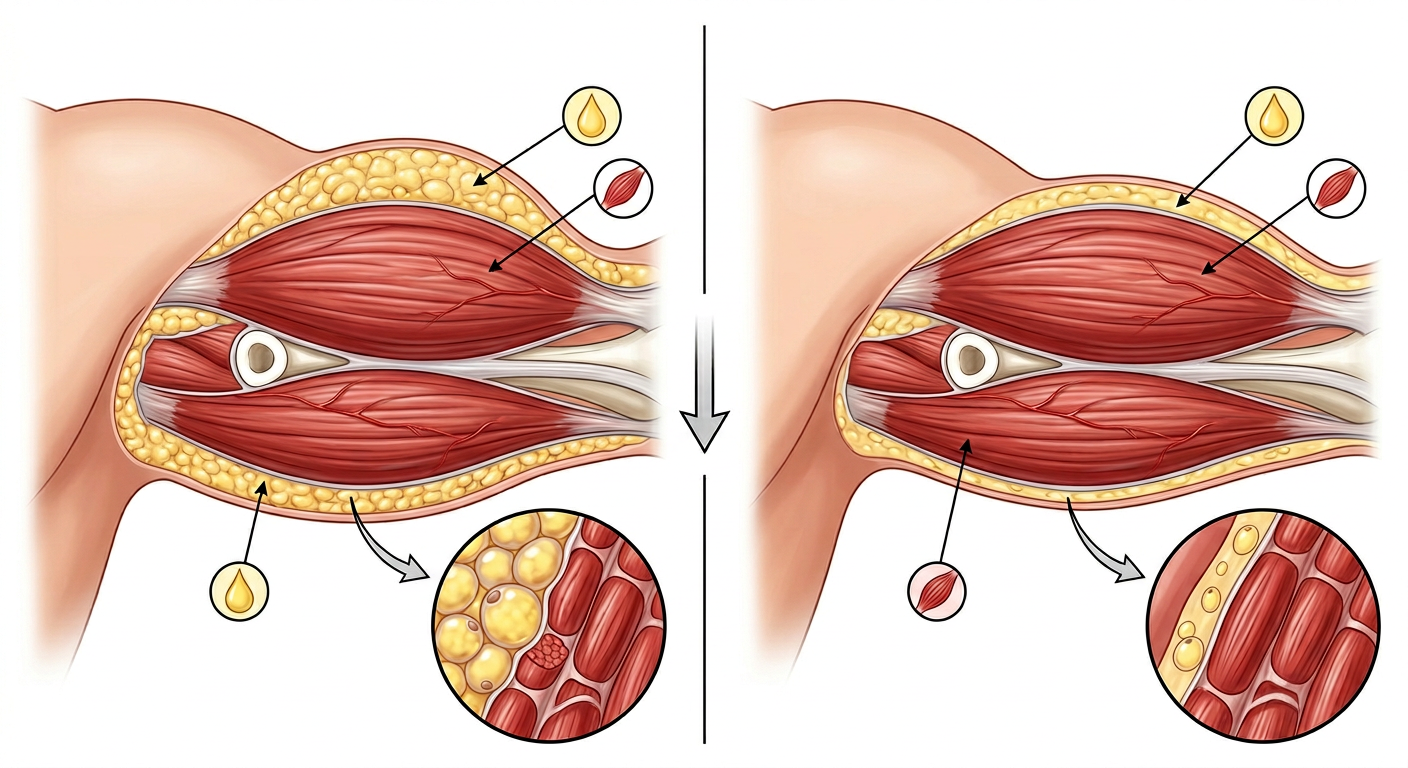
GLP-1 receptor agonists like semaglutide and tirzepatide have reshaped obesity treatment, producing weight loss results that were unthinkable a decade ago. But a significant and underreported side effect is emerging alongside the headlines: these medications cause substantial loss of lean body mass — the muscle, bone, and organ tissue that is not fat.
A January 2026 review in the Journal of Clinical Medicine from researchers at the University of Nebraska Medical Center examines this problem systematically, surveying both the mechanisms of muscle loss during weight reduction and the pharmacological candidates being developed to prevent it. Among the most promising: tesamorelin, a peptide already FDA-approved for a different indication.
The Muscle Loss Problem
Weight loss — regardless of how it is achieved — involves losing some mixture of fat and lean tissue. The ratio matters enormously for health outcomes. Preserving muscle during weight loss is associated with better metabolic function, reduced fall risk, improved physical performance, and long-term maintenance of lost weight.
The concern with GLP-1 receptor agonists is that studies indicate roughly 25–40% of the total weight lost on these medications comes from lean mass rather than fat. For someone losing 50 lbs on semaglutide, that could mean 12–20 lbs of muscle and lean tissue lost alongside the fat.
This is not unique to GLP-1 drugs — aggressive caloric restriction and rapid weight loss from any cause produce similar ratios. But the scale and speed of GLP-1-induced weight loss, combined with the massive and growing population using these medications, has made the muscle loss question newly urgent.
The underlying mechanisms are multiple:
- Reduced caloric intake — the primary driver of GLP-1’s effect — limits amino acid availability for muscle protein synthesis
- Reduced physical activity — some patients report fatigue and reduced exercise tolerance, particularly early in treatment
- Altered hormonal environment — changes in insulin, IGF-1, and other metabolic hormones affect muscle anabolism
The Peptide Solutions Being Studied
The review surveys several pharmacological classes targeting muscle preservation, with two peptide-related approaches standing out:
Tesamorelin: The GHRH Analogue
Tesamorelin is a synthetic analogue of growth hormone-releasing hormone (GHRH) — the hypothalamic peptide that signals the pituitary to produce growth hormone. It is FDA-approved specifically for the reduction of excess abdominal fat (lipodystrophy) in HIV-positive patients on antiretroviral therapy.
Its mechanism is different from anabolic steroids or SARMs: rather than directly supplying hormones or binding androgen receptors, tesamorelin stimulates the pituitary’s natural GH production through the same physiological pathway the body uses. This means GH release remains subject to normal feedback regulation, which is proposed as a safety advantage.
In the HIV lipodystrophy context, tesamorelin’s effects on body composition have been well-documented: it reduces visceral fat while preserving or improving lean mass. Researchers are now investigating whether this lean-mass-sparing effect could translate to obesity patients losing weight on GLP-1 medications.
No large clinical trials combining tesamorelin with GLP-1 agonists have published results as of this writing, but the physiological rationale is compelling, and investigator-initiated studies are underway. Tesamorelin is currently available only by prescription for its approved indication; off-label use is not standard of care.
Bimagrumab: The Activin Receptor Inhibitor
Bimagrumab represents a different peptide-derived approach. It is a monoclonal antibody that blocks activin type II receptors — the pathway that signals muscle breakdown and limits muscle growth. By blocking this signal, bimagrumab promotes muscle growth (and secondarily, fat reduction) through a mechanism entirely distinct from GH-axis interventions.
Phase 2 clinical trials have shown that bimagrumab can significantly increase lean mass while decreasing fat mass in patients with obesity — including some who were also on GLP-1 medications. These results have generated substantial interest as a potential complementary therapy.
Bimagrumab is investigational and not yet approved. Phase 3 trials are ongoing.
Enobosarm (Ostarine): The SARM
The review also covers enobosarm, a selective androgen receptor modulator (SARM). Unlike the peptide-derived approaches above, enobosarm works through androgen receptor pathways. It is investigational and not approved for any indication in the US; the review includes it as part of the pharmacological landscape being explored.
The Broader Clinical Picture
The muscle loss problem during GLP-1 therapy is likely to drive a wave of combination treatment research over the next several years. The most plausible clinical scenario is a GLP-1 agonist combined with a lean-mass-preserving agent — achieving the metabolic benefits of weight loss while protecting the muscle that makes long-term outcomes favorable.
Tesamorelin’s existing FDA approval and established safety record give it a practical advantage in this research landscape: there is already a body of human safety data to build on. Bimagrumab’s striking Phase 2 results make it a high-priority investigational candidate.
For patients currently on GLP-1 medications, the review underscores the importance of resistance exercise as the most evidence-backed tool available right now for minimizing muscle loss during weight reduction. Pharmacological adjuncts remain investigational.
What This Means for Informed Consumers
If you are on semaglutide, tirzepatide, or another GLP-1 medication for weight loss, this research context is directly relevant to you:
- Ask about lean mass monitoring. Body composition measurement (DEXA scan or bioelectrical impedance) can track whether you are preserving muscle, not just losing weight.
- Prioritize resistance training. The evidence for resistance exercise in preserving lean mass during caloric restriction is strong and applies here.
- Watch the pipeline. Tesamorelin and bimagrumab are among the most interesting candidates, but neither is currently standard of care for this application. Unregulated sources are dangerous.
- Discuss with your prescriber. If muscle loss is a concern, your physician can help you understand monitoring and intervention options within what is currently approved.
Source
Arora G, Conde KR, Desouza CV. “Pharmacologic Treatments for the Preservation of Lean Body Mass During Weight Loss.” Journal of Clinical Medicine. January 9, 2026;15(2):541. PMID: 41598480 | DOI: 10.3390/jcm15020541
Stay Informed on Peptide Research
Get the latest peptide research, regulatory updates, and clinical findings delivered to your inbox weekly. No spam — unsubscribe anytime.
No spam. Unsubscribe at any time. See our Privacy Policy.